What Schools Don't Teach About AI
Schools are using AI to help kids learn better. But the job market is asking a completely different question.
A recent Anthropic report looked at how AI is already affecting jobs. The finding that stuck with me: “hiring for recent college graduates in AI-exposed roles has dropped about 14% compared to pre-ChatGPT days.”
And it’s not the manual jobs going first. It’s the jobs schools are actively preparing kids for: computers, math, business, engineering, arts, legal, medicine, office administration, sales. The more a job looks like something AI can do, the less it’s growing.
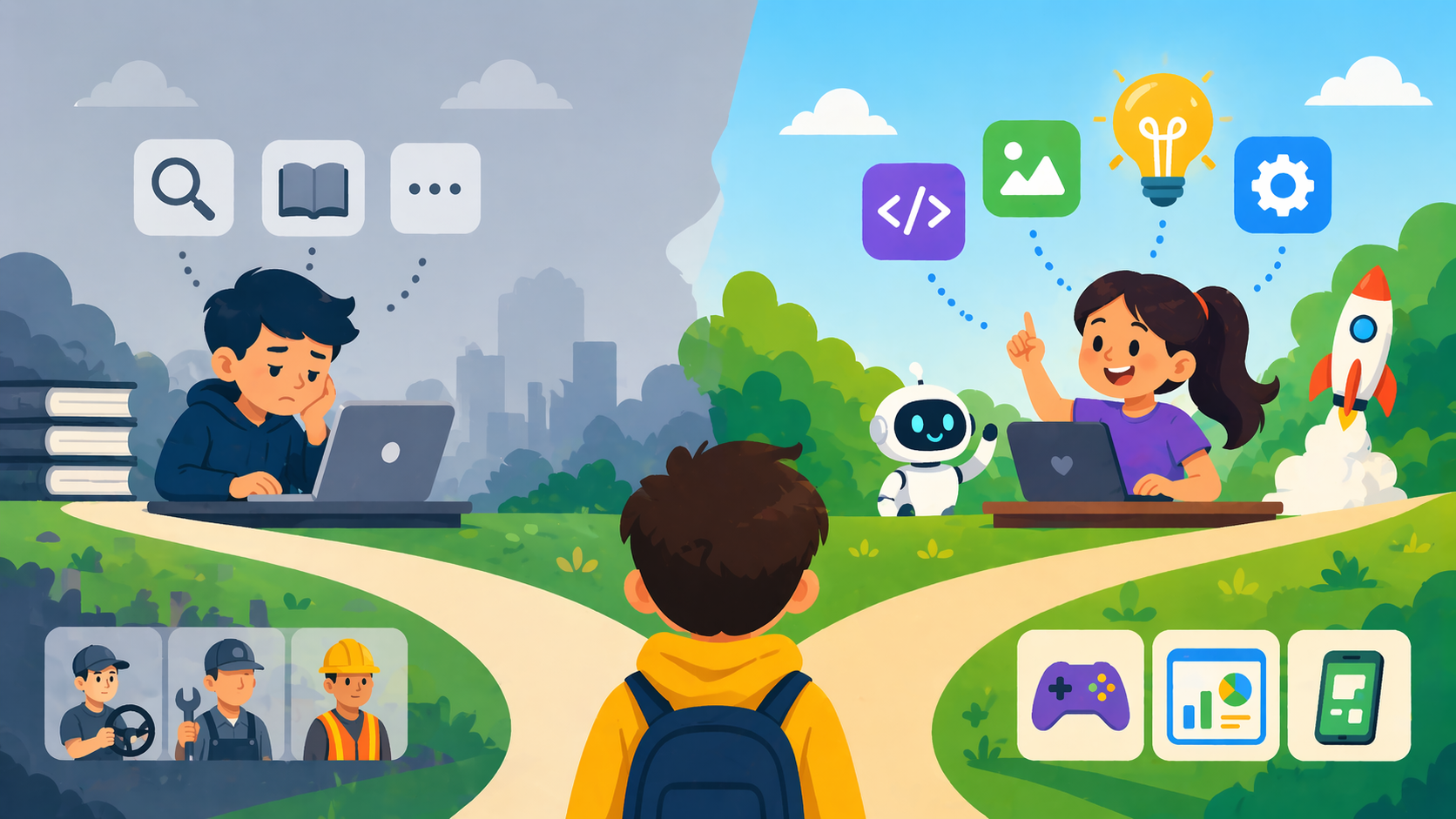
Meanwhile, the least affected jobs are physical and manual - drivers, mechanics, plumbers, farmers, construction workers. AI is coming for cognitive, knowledge-heavy work first. The kind that schools optimise for.
So what are schools doing about this?
Most schools are using AI as a smarter textbook. Kids use it to research topics, write better essays, get personalised explanations, solve math problems faster. The SAMR framework calls this “Enhancement”: using new technology to do old things slightly better. It sounds progressive. It isn’t.
Because the job market isn’t asking “can you use AI?” It’s asking “can you build with AI?” ✨
The split that matters
I’ve been designing how people learn for 15 years. And I keep seeing the same pattern forming:
- Kids who use AI to consume and assist become increasingly replaceable.
- Kids who use AI to create and build become increasingly valuable.
Same tools. Completely different relationship with them.
- Consumption mode is a child asking AI a question, getting an answer, moving on.
- Creation mode is a 9-year-old using ChatGPT voice to build a game that teaches their sibling basic math.
- A 13-year-old building a data dashboard with Claude to track something they actually care about.
- A 16-year-old shipping a real app using no-code tools and AI to fill in the gaps.
The question isn’t whether your child can use AI. It’s whether your child can build something with AI that didn’t exist before. 😊
What teachers and parents can actually do?
One move for teachers: replace one project a term. Instead of “use AI to research this topic”, make it “use AI to build something about this topic.” Not a report. Not a summary. A thing - can be a game, a tool, a prototype. Something that required a decision, a mistake, and a revision. That single shift moves a classroom from Enhancement to Redefinition in the SAMR model. Same tools, different prompt to the class.
One move for parents: change the question you ask at the end of the day. Not “did you finish your homework?” but “what did you make today?” - or better, “what do you want to build?”. It doesn’t have to be big. A doodle. A small web app project. A story written with AI as a collaborator. The habit of making, even in small doses, builds a fundamentally different mindset than the habit of completing.
The skill path
If raising a builder sounds abstract, it isn’t. The underlying skills stack, in order: math and logic, then coding, then data intelligence, then AI foundations, then design and innovation. Each one builds on the last. Together they make a kid who doesn’t just survive the AI era … they help shape it. 🚀
This is exactly what I’m trying to build with Lernok.
The question isn’t whether AI will change your child’s future. It already is.
The real question is whether your child ends up being someone this happens to, or someone who makes it happen.
— Nehal